Sponsorship Pricing
Part of Creator sponsorship pricing
Comparing a fixed sponsorship fee with a revenue share
Compare a fixed sponsorship fee with revenue share using the same deliverables, clear sales definitions, reporting access and a break-even example.
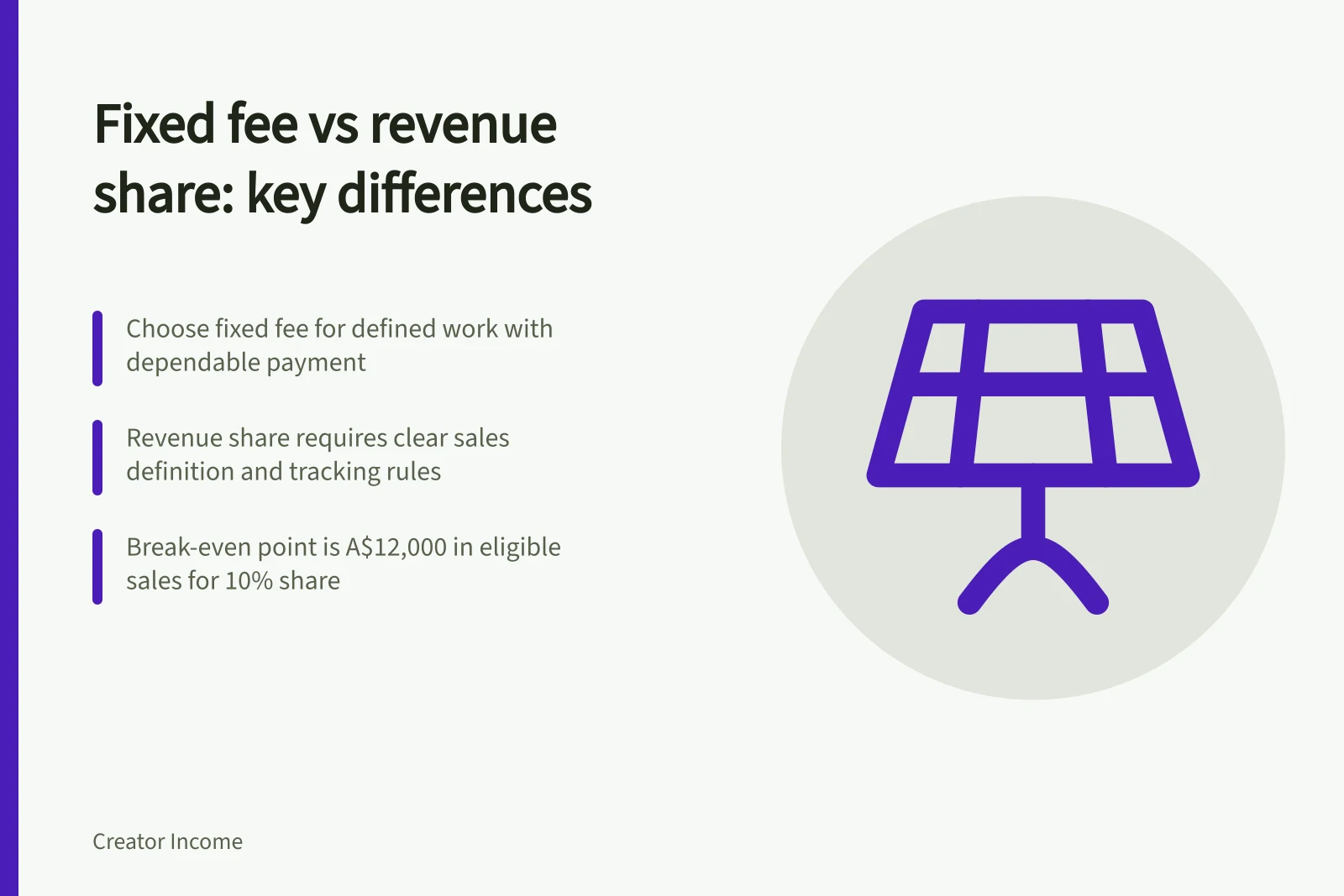
Choose a fixed fee when the sponsor buys defined work and you need dependable payment for delivering it. Consider a revenue share when both parties can define eligible sales, check the calculation and bear the uncertainty. A hybrid can fund production while tying some payment to measured results.
Compare who carries the risk
| Term | Fixed fee | Revenue share |
|---|---|---|
| Payment basis | Agreed amount for specified work and rights | Agreed percentage or amount per eligible transaction |
| Creator's main risk | Extra work or broad rights hidden in the scope | Few credited sales, reversals or missing reporting |
| Sponsor's main risk | Paying even if the campaign produces no measurable sales | Disputes over attribution or the calculation base |
| Records needed | Accepted brief, milestones and invoice | The brief plus transaction definitions, reports and adjustments |
Neither structure guarantees a good deal. A fixed fee can be too low for the work. A large percentage can return little if eligible sales are scarce or cannot be verified.
Compare the same scope
Document deliverables, publication dates, review rounds and usage rights first. Keep them identical while comparing payment options. Otherwise a larger percentage may pay for more content or broader reuse.
For a fixed fee, agree whether payment falls due at signing, at a milestone or after delivery. Account for production expenses you pay before the sponsor pays. For a revenue share, state whether a guaranteed minimum is additional to the share or an advance deducted from later share payments.
Define the revenue share
“Ten per cent of sales” leaves essential questions unanswered. Identify the eligible product, customer and channel, the event that earns a share, the currency, the calculation base and the reporting period.
State how discounts, GST, returns, refunds, cancellations and chargebacks affect the amount. Agree on the tracking method, the report you will receive and when payment is due.
A code or tracked link can miss purchases made another way and may credit purchases the creator did not cause. Treat the agreed tracking rule as a way to allocate payment, not as proof of every buyer's motivation. If the sponsor will not provide records sufficient to check the calculation, the share is difficult to assess.
Run a break-even example
Suppose two otherwise identical hypothetical offers: A$1,200 fixed or 10% of eligible sales. For this arithmetic example, assume the defined sales base already accounts for any applicable GST, discounts and reversals.
The share matches the fixed amount at A$12,000 in eligible sales. At A$8,000 it pays A$800; at A$20,000 it pays A$2,000. These are possible calculation results, not campaign forecasts or market rates.
The break-even figure helps only after the sales definition and attribution window are settled. Check when you will receive the report and payment, and estimate production costs separately under each option.
Decide and document the choice
A fixed fee may suit substantial work or a deal where reliable sales reporting is unavailable. A share may suit a narrow eligible action, accessible records and a low result you can afford. A hybrid may suit both sides when production needs funding and they want to share some upside.
Put the chosen structure, definitions, payment dates and dispute process in the agreement. After the campaign, compare amounts paid with the records and time spent. The proposed calculation is a decision tool, not evidence of campaign performance.