Sponsorship Pricing
Part of Creator newsletters as a business
Choosing a sponsor format for a newsletter
Compare brief placements, sponsor sections and dedicated issues, then define disclosure, approvals and honest reporting.
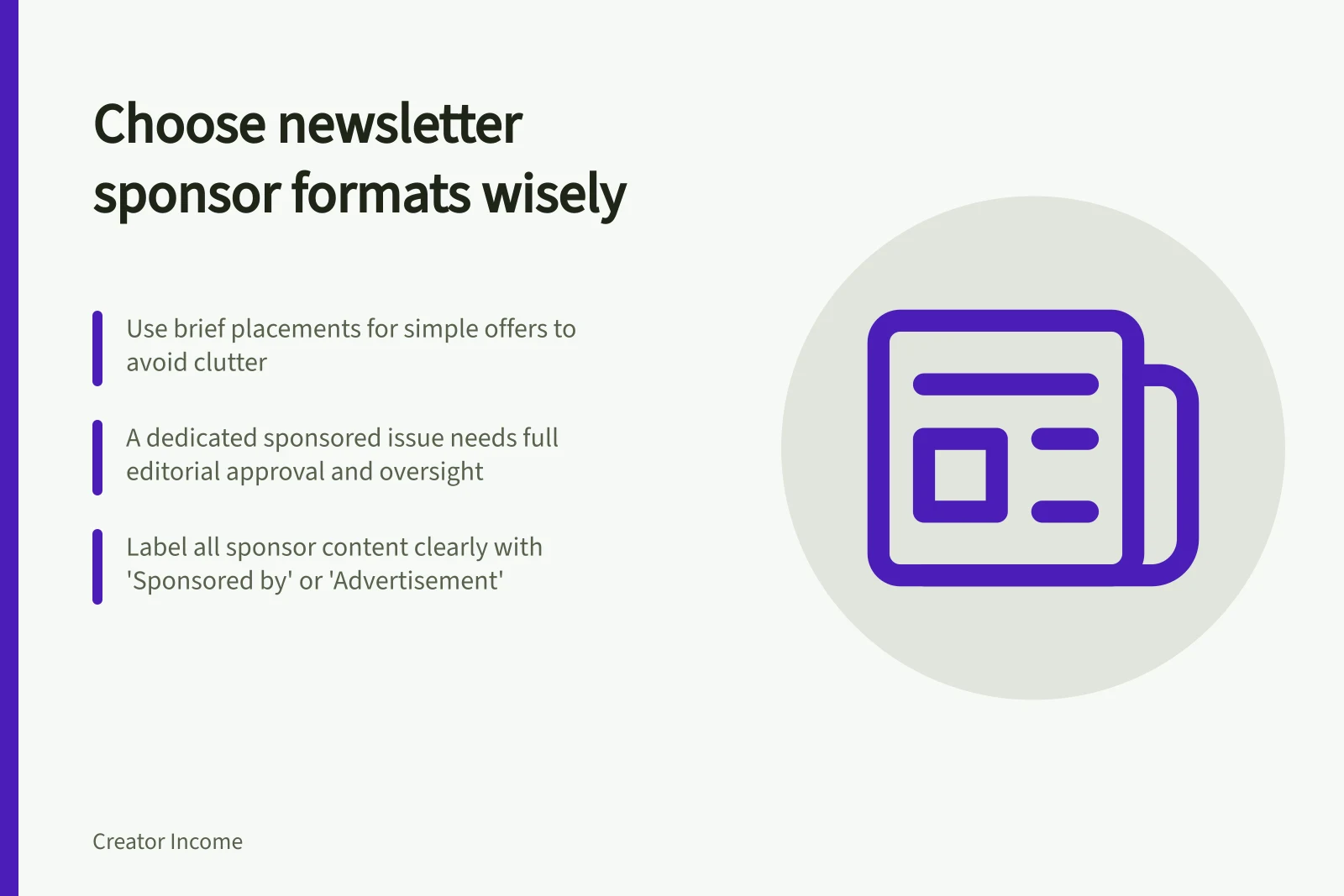
Choose the smallest sponsor format that lets the advertiser make a clear, relevant offer without confusing readers about who wrote it. A short labelled placement may suit a straightforward offer. A dedicated sponsored issue needs more editorial and approval work because the commercial message occupies the whole email.
Match the format to the job
| Format | Useful when | Main risk to manage |
|---|---|---|
| Brief placement in a regular issue | The offer can be understood in a few lines | The label or link gets lost among editorial items |
| Clearly separated sponsor section | The offer needs context or a demonstration | The section begins to look like independent editorial advice |
| Dedicated sponsored issue | Readers would genuinely value a substantial, relevant explanation | Sponsor control overwhelms the publication's usual promise |
Ask what the sponsor wants readers to do: visit a page, register interest or consider a product. Then ask whether the newsletter audience has a reason to care. A large placement will not repair a weak fit. Reject claims you cannot check, and do not imply that you have used or endorsed a product if you have not.
Specify the placement before pricing it
A useful brief records the issue date, position, approximate length, number of links, supplied assets, disclosure wording, approval deadline and what happens if publication is delayed. It also says whether the creator writes the copy or the sponsor supplies it. Agree on how many review rounds are included and who checks product claims.
Separate the rights involved. Paying for one placement does not, by itself, settle whether the advertiser can reuse the newsletter's wording or the creator's name in other channels. Put any additional use in the agreement with its duration and context. Keep the sponsor's approval confined to the agreed commercial material so readers can still rely on the publication's editorial judgement.
Make the commercial relationship visible
Label the placement where a reader encounters it, using plain language such as “Sponsored by” or “Advertisement”. A vague abbreviation or a disclosure hidden at the end of a long email can leave the relationship unclear.
A useful test is whether a reader can tell, at the point of the recommendation, that it is sponsored. They should not have to infer the relationship.
Check that readers expect this kind of message and that it is clear who sent it. Give them an easy way to manage or stop future emails.
Report only what the format can show
Define the reporting fields in advance. Successful deliveries show how many addresses accepted the email; sponsor-link clicks show recorded actions on that link. Neither proves that every recipient read the placement. Open tracking can be distorted by privacy settings and automated activity.
If the sponsor needs a specific business result, agree on a measurement method the parties can actually observe. That might be a tagged landing page or a sponsor-reported enquiry count, with its limitations stated.
After a placement, record reader complaints, unsubscribes and editorial time alongside the fee. A format can pay well for one issue yet damage the value of future issues if it interrupts what readers signed up for. Use that evidence to decide whether to repeat, shorten or retire the format.
Key Metrics to Report After Sponsor Placement
- Successful deliveries
- Number of addresses that received the email
- Link clicks
- Recorded actions on the sponsor’s link
- Open tracking accuracy
- Limited by privacy settings and automated activity
- Reader complaints
- Logged post-publication
- Unsubscribes after placement
- Monitored for impact on audience trust
- Editorial time spent
- Recorded for cost-benefit analysis