Sponsorship Pricing
Part of Revenue planning for independent creators
Advertising, services and audience payments compared
Compare creator advertising, client services and audience payments by buyer, payment trigger, delivery work and uncertainty.
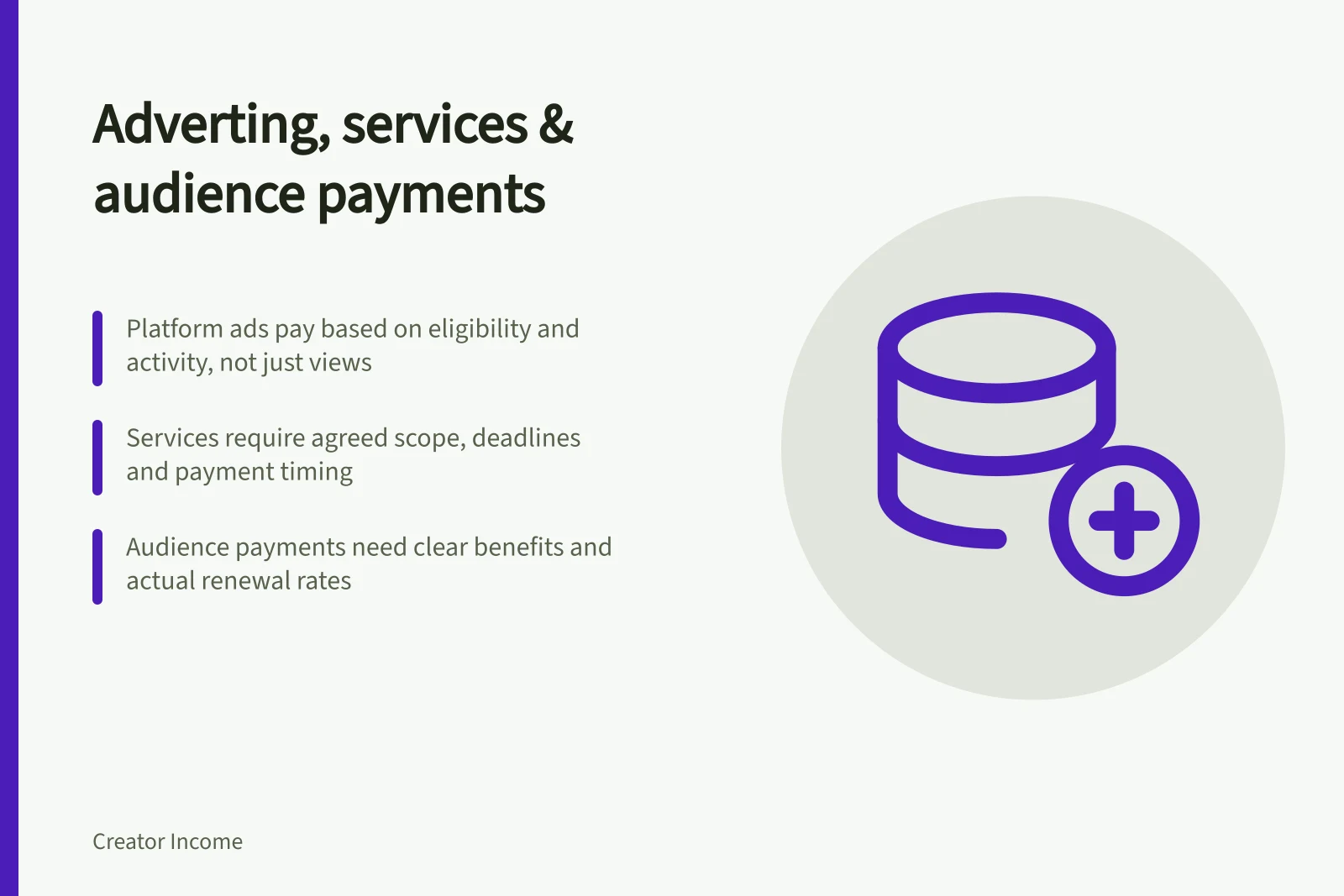
Advertising, services and audience payments differ in who pays, what triggers payment and what the creator must deliver. Compare those conditions before comparing headline amounts. Audience size alone does not establish ad income, a client fee does not reveal the hours required, and a recurring payment brings a continuing promise.
| Model | Who pays | Payment basis | Main constraint |
|---|---|---|---|
| Platform advertising | The platform under its monetisation arrangement | Eligible advertising activity under its terms | Eligibility, content rules and variable earnings |
| Services | A client | Agreed work or a defined deliverable | Scope, capacity and payment timing |
| Audience payments | A reader, viewer or supporter | A purchase, contribution or promised benefit | Delivery, support and possible refunds |
These are models, not rates. Use your own agreements and transaction records to compare results.
Platform advertising
Advertising can suit content that reaches people repeatedly without a separate sale to each viewer. Attention alone, however, does not establish a payable amount; earnings depend on the relevant platform or advertising agreement.
Check the platform's current eligibility terms, reported earnings and actual payouts. Directly selling an ad placement to a brand requires a separate agreement and should be assessed as sponsorship work.
Services
A service suits work a client can specify and assess, such as editing a set of videos or advising on a defined problem. Describe the output, deadline, review rounds, payment terms and work outside scope. Estimate the time spent finding the client as well as delivering the work.
Capacity is the main constraint. Another client can mean more hours, and a vague brief can expand after the price is agreed.
Compare paid projects with all the time and costs they required. An agreed fee does not pay a bill until the money arrives.
Audience payments
A one-off purchase or contribution creates a different obligation from a recurring membership. For a recurring offer, explain what buyers receive each period and what support is included. Use actual paying accounts and accepted terms when assessing renewals; do not assume followers will become members.
Make the choice
For each candidate, write down the buyer, offer, payment trigger, likely collection date, direct costs and hours required. Mark each amount as observed, agreed or assumed.
Then choose the model whose work and uncertainty you can sustain. Combining models can help, but each additional offer also adds delivery obligations.