Sponsorship Pricing
Part of Creator payment operations
Handling delayed sponsor payments: what to do
Check the sponsor agreement and delivery record, request a payment update, and choose a proportionate next step for an overdue fee.
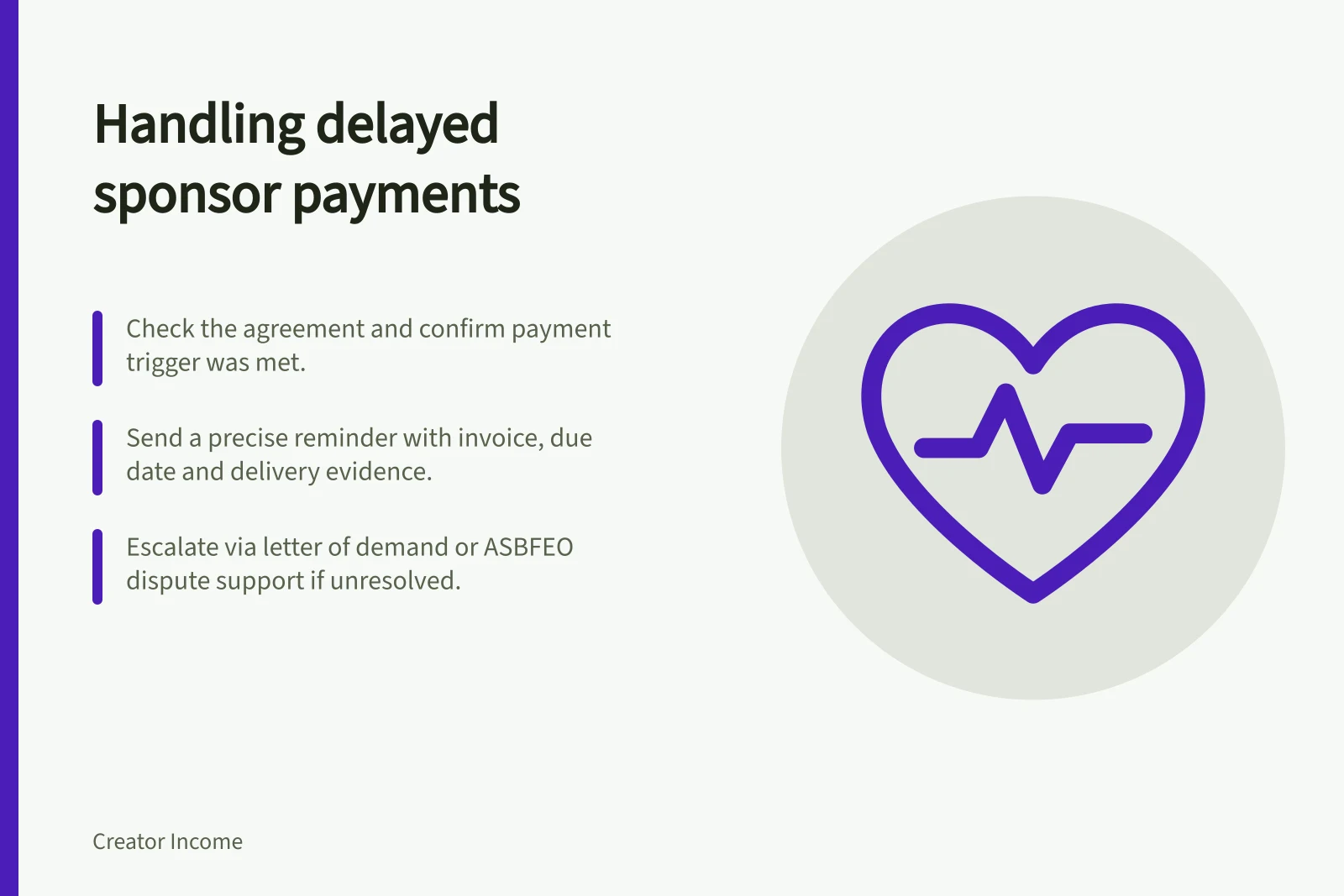
When an agreed creator sponsorship fee misses its due date, check the agreement and confirm the payment trigger was met. Then find out what is holding payment, send a precise reminder, keep a clear record and escalate if reminders do not resolve the issue.
Identify what is holding payment
Retrieve the accepted agreement, approved deliverables, evidence of publication or delivery, invoice and correspondence. Check who must pay, the purchase-order reference, submission portal, due date, payment method and any approval step.
The person who approved the creative may not handle accounts payable. Confirm that the invoice reached the right billing route and ask whether any approval is outstanding.
A delay may involve an administrative hold, missing approval, a dispute about scope or amount, or lateness without a clear explanation. These are possibilities, not conclusions about the sponsor’s motives; ask them to identify any missing document or objection in writing.
Do not change the agreed fee or add a new delivery condition because payment is late. Keep the request focused on the agreed payment terms and the evidence that the trigger was met.
Send a precise reminder
Identify the campaign and invoice, amount and currency, due date, and evidence that the agreed payment trigger was met. Ask whether the invoice is approved for payment, whether anything is missing and what transfer date the sponsor expects.
You could write: “Subject: Follow-up: [campaign] — invoice [reference]. Our records show [amount and currency] was due on [date], and the agreed [payment trigger] was met on [date]. Could you confirm whether the invoice is approved for payment? If not, please identify any missing document or discrepancy and confirm the expected transfer date, or propose a revised date or payment schedule.”
Keep the reminder, reply and any written confirmation of a revised date or instalment arrangement with the agreement, invoice and delivery evidence. Mark the fee outstanding until a payment record confirms receipt.
If part payment arrives, allocate it to the invoice and leave the balance visible. If payment is short or arrives in another currency, ask for a remittance explanation before closing the item, and retain the original invoice and any later adjustments.
Decide whether to escalate
Read the agreement’s notice and dispute terms before taking a formal step. The Australian Government’s business.gov.au guidance, “What to do when you haven't been paid”, recommends reviewing the contract and sending a reminder before considering later steps.
If reminders receive no response, business.gov.au says to consider a letter of demand, or ask a legal professional to draft one. Business Victoria provides templates for a reminder email about an overdue payment, a second reminder email and a final notice email.
If the issue is a dispute that contact has not resolved, the Australian Small Business and Family Enterprise Ombudsman (ASBFEO) offers an online dispute support tool to find low-cost dispute resolution services in your area, information on five steps to resolve a dispute and a team to help with the process. Mediation is one common way to work towards an agreement; the Australian Mediator and Dispute Resolution Accreditation Standards website has a directory of nationally accredited mediators.
If friendly reminders, informal negotiations and a letter of demand do not recover the debt, business.gov.au says you may consider a debt collection service and should tell the sponsor if you plan to use one. Check the Australian Competition and Consumer Commission’s debt collection information for legal and consumer obligations when contacting another business about a debt.
Legal action is a later option if other steps have not worked. The right next step depends on the evidence, amount, agreement and cost; seek legal advice before relying on a particular remedy or making a formal allegation.
Continue to assess existing delivery obligations under the agreement. If the sponsor asks for additional content while the fee is overdue, define that new work separately, and do not plan production spending as though the unpaid fee has arrived.
After resolution, record what held up payment, such as a missing purchase order, an unclear milestone or a dispute about acceptance. Keep that record with the campaign and payment correspondence.