Memberships
Part of Paid community offers
Defining a paid community's ongoing value
Describe what paid community members can count on each period, including when peer conversation is quiet, and check whether the promise is clear.
Ongoing value is something a member can use or experience during each paid period, even when other members are quiet.
State what you will provide, what members may do, and which benefits depend on voluntary participation.
Find the reason to return
Choose one member situation and finish the sentence: “When I return next month, I can…” The answer should name a useful activity or resource.
Access to a chat room describes a feature; it does not yet explain what the member can do with it.
Separate the offer into three parts:
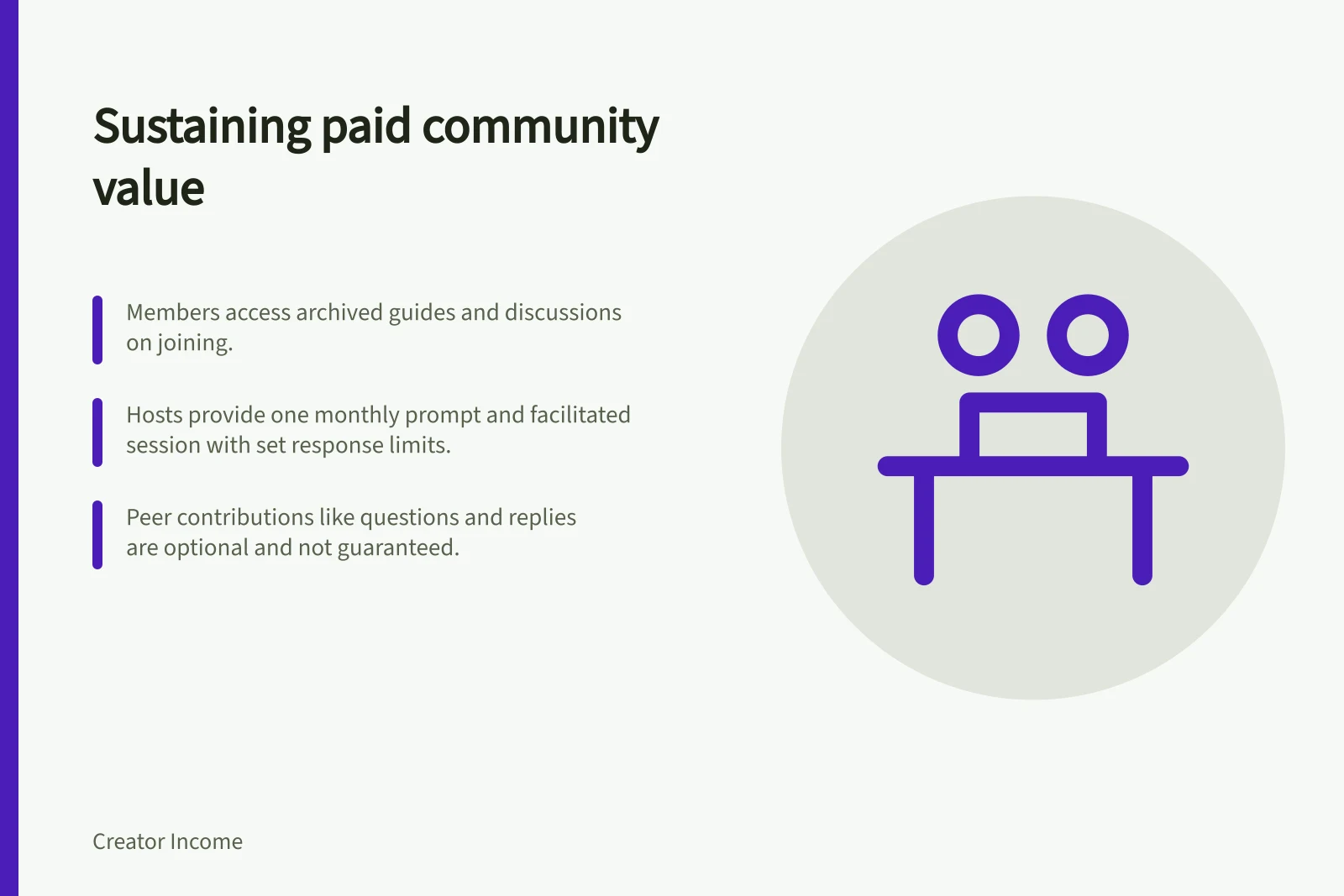
- Available on joining:an archive, guide or existing discussion a new member can navigate.
- Provided by the host:a scheduled prompt, facilitated session or response within stated limits.
- Created by members:questions, examples and peer replies that may enrich the space but cannot be guaranteed.
If peer exchange is central, acknowledge that participation varies and explain how the host will keep the space usable when it is slow.
Write a promise a quiet month can satisfy
A bounded example is: “Each month I post one worked project question and facilitate one scheduled discussion. Members may ask and answer questions. Individual critiques are not included.”
This is sample offer wording, not a recommended frequency or a tested product.
Read the promise as a prospective member. Does it say when the host contribution arrives? Does it imply a personal reply? Does “access” mean an archive, an event or the ability to post?
Replace broad claims such as “active” or “exclusive” with the parts of the offer a buyer can assess.
Members who read without posting may still benefit. Do not make posting a condition of belonging unless it is essential and disclosed before payment.
Explain whether work shared in the group stays there, and seek permission before featuring a member’s contribution elsewhere.
Check understanding and delivery
Before launch, show the description and a representative sample to people who fit the intended group.
Ask what they expect during a normal month and what they would receive if nobody else posted. Their answers can expose unclear wording; they do not prove demand or future activity.
After launch, compare the promise with what you delivered. Keep dated records of host contributions, sessions, answered questions and problems.
Invite optional feedback from quiet members too. A busy channel is not necessarily useful, and a slower one may still help people complete a specific task.
Keep this community promise centred on work people can do together and facilitation you can sustain. If members chiefly buy your published work, describe that benefit directly in the wider membership offer.
Key Metrics to Track Post-Launch
- Host contributions delivered
- Number of scheduled prompts, sessions, or responses per month
- Questions answered by host
- Count of queries addressed within stated limits
- Member posts (voluntary)
- Average number of peer contributions monthly
- Feedback from quiet members
- Optional survey responses from non-active participants