Memberships
Part of Paid community offers
Handling member expectations when activity is low
Respond to a quiet paid community by checking the original promise, delivering host contributions and telling members when the experience changes.
When a paid community is quiet, compare what members receive with what they were told they were buying. Deliver the host contributions you promised, explain any gap and offer a useful next step without making members responsible for creating activity. Low posting matters most when it reduces the benefit you sold.
How to handle low activity in a paid community
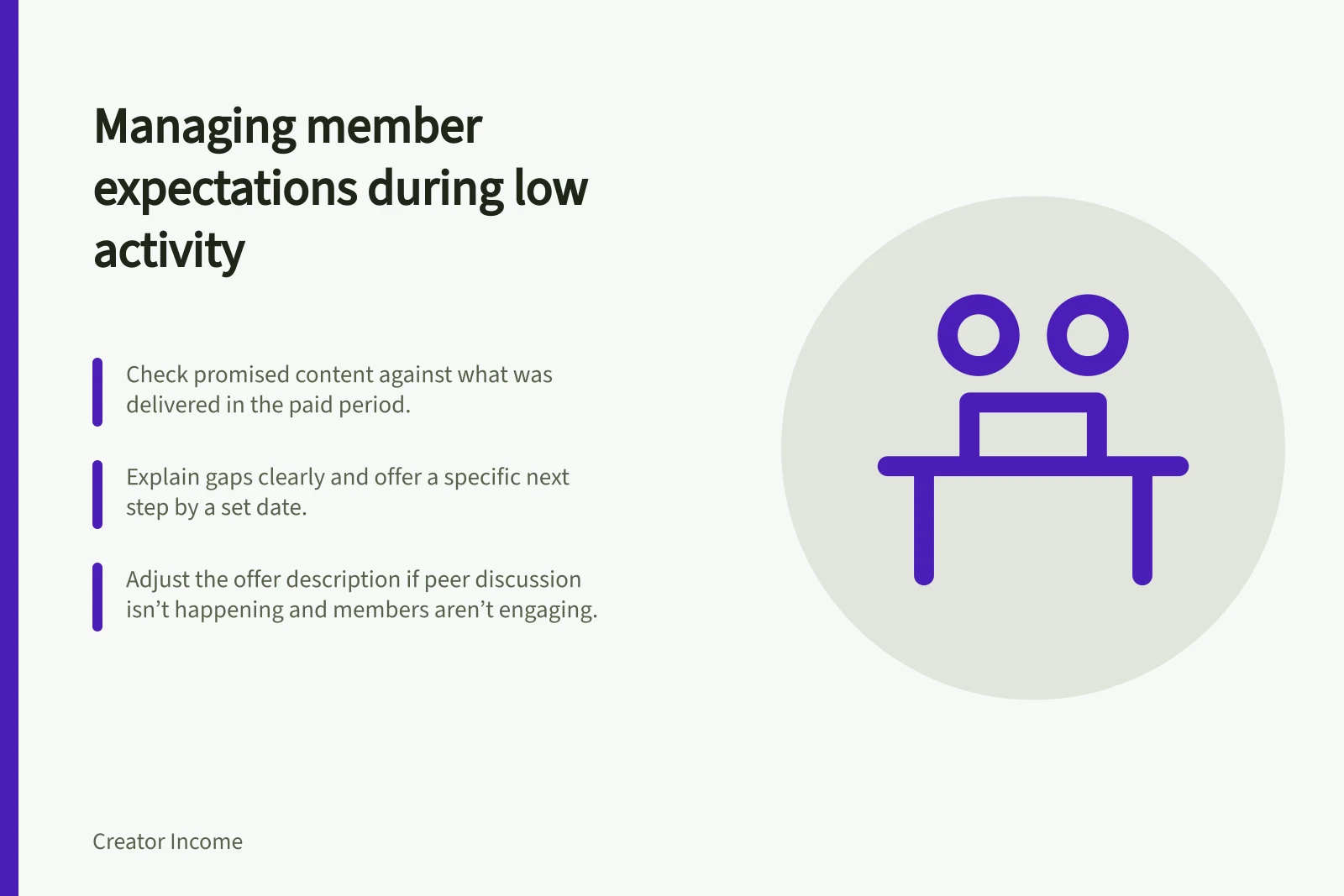
- Check the original promiseReview sign-up pages, welcome messages, and event schedules to confirm what was promised. Compare with what was delivered in the current period.
- Offer one useful next stepProvide a specific, purpose-driven prompt (e.g., ‘Which part of [shared task] are you working on?’) instead of asking members to ‘get active’.
- Explain any material gapIf a promised session, response or resource is missed, state what happened, what’s available now, and when it will be resolved—only if you can meet the commitment.
- Decide whether the offer needs changeReview each paid period using delivery data, feedback, cancellations, and support requests. Adjust messaging or format if peer interaction remains absent.
Check the original promise
Read the sign-up page, welcome message and event schedule as a member would. For each promised item—such as peer replies, access to your guidance, a scheduled session or a place to discuss a topic—note what was delivered in the current paid period. This makes it easier to distinguish a missed host commitment from low voluntary participation.
Ask quiet members privately and optionally: “What have you been able to use so far, and what would make the offer more useful to you?” Some members may get value without posting; others may be unsure what belongs in the group or reluctant to start a thread. A few replies cannot represent everyone’s experience.
Offer one useful next step
Tie a prompt to the group’s purpose rather than asking members to “get active”. For example: “Which part of [shared task] are you working on, where are you stuck, and what have you tried?” You can show the detail you welcome with a fill-in example: “I’m working on [step]; I’m stuck at [point]; I’ve tried [approach].”
If you schedule a discussion, tell members what you will do even if few attend: “In [session], I’ll cover [topic] and answer questions. Even if attendance is low, I’ll still [specific host contribution].” Fill in only what you can deliver; don’t make members responsible for sustaining the session.
Avoid activity contests, repeated requests for individuals to post and public lists of inactive members. These can put the work of sustaining a paid offer onto people who may have joined to learn quietly.
What to do when your paid community is quiet
- Tie prompts to the group’s purposeAvoid generic calls to ‘post more’; instead ask about progress on shared tasks.
- Show an example responseUse a fill-in template like: ‘I’m working on [step]; stuck at [point]; tried [approach].’
- Commit to host-led value even if few attendState clearly: ‘I’ll still [specific contribution] even if attendance is low.’
- Avoid public shaming or contestsDon’t use leaderboards, repeated individual requests, or lists of inactive members.
Explain a material gap
If you miss a promised session, response or resource, state what happened, what is available now and when you expect to resolve the gap. For example: “I missed [promised item] in [paid period]. What is available now is [current material or support], and I expect to [specific next step] by [date].” Use a date only if you can meet it.
If peer conversation was central to the sales description but is not emerging, say how the space currently works and what host-led value you can provide. You could add: “If this no longer matches what you bought, contact me privately via [support contact] so we can discuss the commitment under the terms you accepted.”
Give members a direct way to raise concerns, such as: “If you have a question about what was promised or what is available, reply via [support contact] and tell me which part you’re asking about.” Keep the update factual, and don’t present a new prompt as a successful fix before members have had a chance to use it.
Decide whether the offer needs to change
Set a review point at the end of each paid period. Compare promised contributions with delivery, then consider attendance, useful questions, optional feedback, support requests and cancellations together. Treat activity as a clue to investigate, not a number to inflate.
If members value host material but rarely talk, describe the offer more accurately to future buyers. For example: “This community provides [host-led material or sessions], with peer discussion when members choose to take part; member replies are not guaranteed.”
If the offer’s main value depends on peer exchange that remains absent, consider a smaller facilitated format or pause new sign-ups while you resolve current commitments. Explain any change to members and promise only steps you can deliver.
Key metrics to track for community health
- Host contributions delivered
- Compare planned vs actual (e.g., sessions held, resources shared)
- Member participation rate
- Track optional feedback, questions asked, and support requests
- Cancellation rate
- Monitor churn after each paid period
- Peer discussion frequency
- Note absence of conversation even if host content is strong
Adjusting your community offer based on activity
- Pros of keeping the current formatMembers may value host-led content even without posting. No need to overcomplicate the offering.
- Cons of keeping the current formatIf peer exchange is central to the offer but not happening, members may feel misled.
- Pros of changing the formatSmaller, facilitated groups or paused sign-ups can improve quality and manage expectations.
- Cons of changing the formatMay reduce reach and create uncertainty; only adjust if you can deliver on new commitments.