Sponsorship Pricing
Part of Creator licensing income
Pricing commercial reuse separately from original production
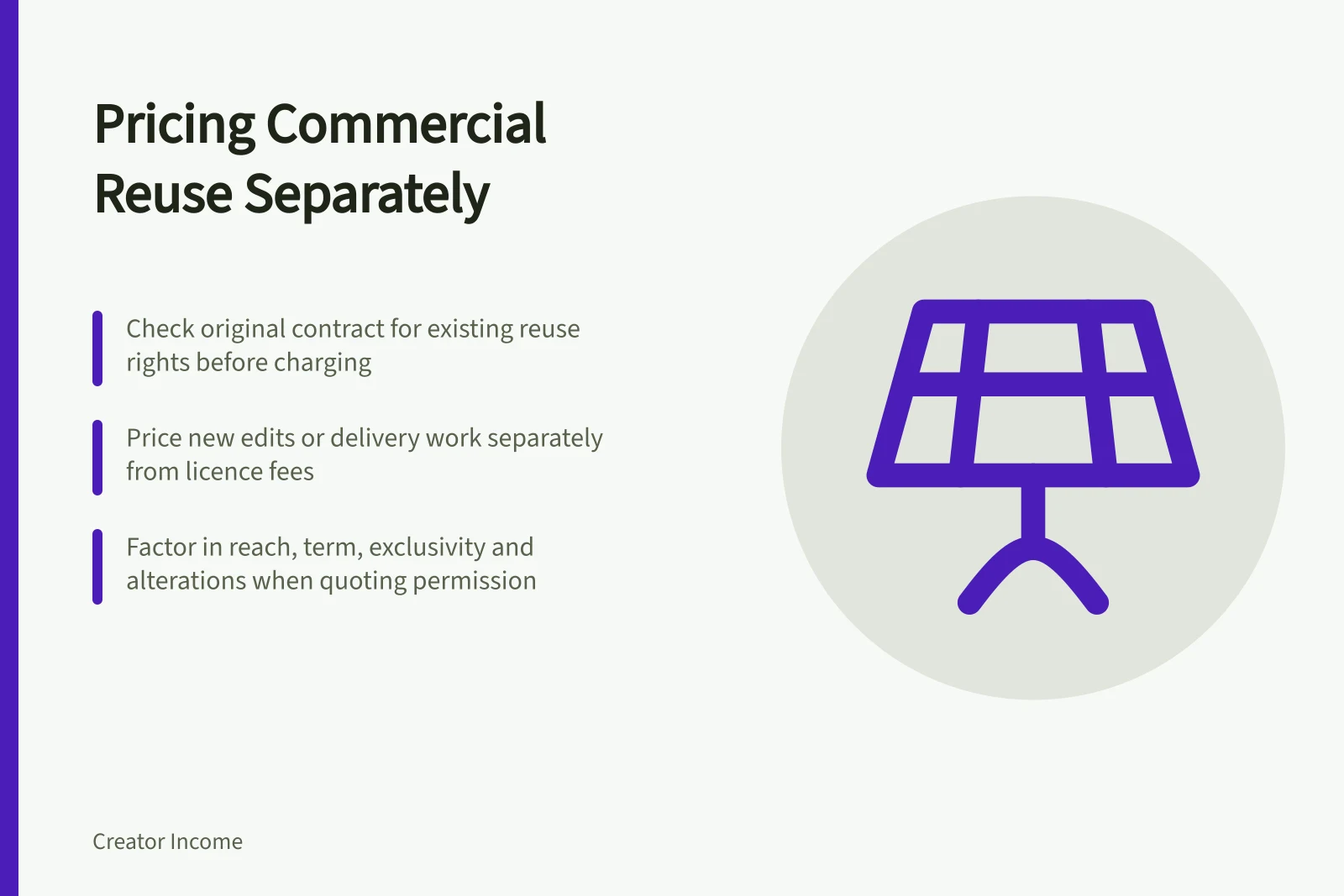
Check existing rights, separate new production from reuse permission and quote a commercial licence by its agreed scope.
If a buyer wants another commercial use of your work, first check whether the original agreement already permits it. If not, quote the additional permission by its scope. Price any new editing or delivery work separately.
Guidance from Australian legal sources
- Contract preparation guidance
- Business.gov.au – Prepare a contract for contractors
- Commission vs. licence clarification
- ArtsLaw Centre of Australia – Commission vs. licence
- Reproduction for publication notes
- ArtsLaw – Image reproduction for a publication (explanatory notes)
Check the first deal
Find the original brief, contract and invoice. Identify who controls the relevant rights and which uses the first payment covered. Do not charge again for a use already granted.
Payment for production does not, by itself, establish that the buyer owns copyright or has unlimited reuse rights. Contractor ownership clauses and the circumstances of a commission can change the position.
Ask for the proposed new use: the asset and version, channels, products, dates, territory, expected distribution, alterations and any exclusivity or onward rights. ‘Reuse in advertising’ is too broad to price clearly if the buyer only plans one paid social campaign.
Price the permission described
Consider the factors that change what you are granting:
- Reach:Is the use confined to one publication or spread across channels, products or markets?
- Term:Is it a fixed campaign or an open-ended request?
- Exclusivity:Would you have to decline other uses within the licensed scope?
- Alteration and onward use:Who may change, reproduce or pass on the work?
- Administration:Would a royalty require sales reports, reconciliation and follow-up?
These are negotiation inputs, not a rate card. A fixed fee may suit a bounded campaign.
A royalty may suit use tied to measurable sales if the parties agree on the calculation base, reporting period, adjustments and payment date. A percentage alone does not establish what will be paid.
Make the quote clear
Show the licence fee beside its permitted use. If the buyer needs a new edit or export, describe and price that work separately.
If no new production is needed, there is no reason to add a production line. Say which changes would need a fresh quote, such as another product, channel, territory or term.
For example, a buyer may have paid for an illustration in one article and later want it on packaging. Check whether packaging was already authorised.
If it was not, ask what products, markets, quantities and period the buyer has in mind. The example establishes no standard price or automatic right to another fee.
Keep the accepted quote with the licence variation and invoice. If the proposed fee is too high for the buyer, a narrower use or shorter term may suit. Record the scope that matches the final price.