Digital Products
Selling digital products as a creator
A practical guide for Australian creators choosing, checking, selling and maintaining a digital product with a clear promise to buyers.
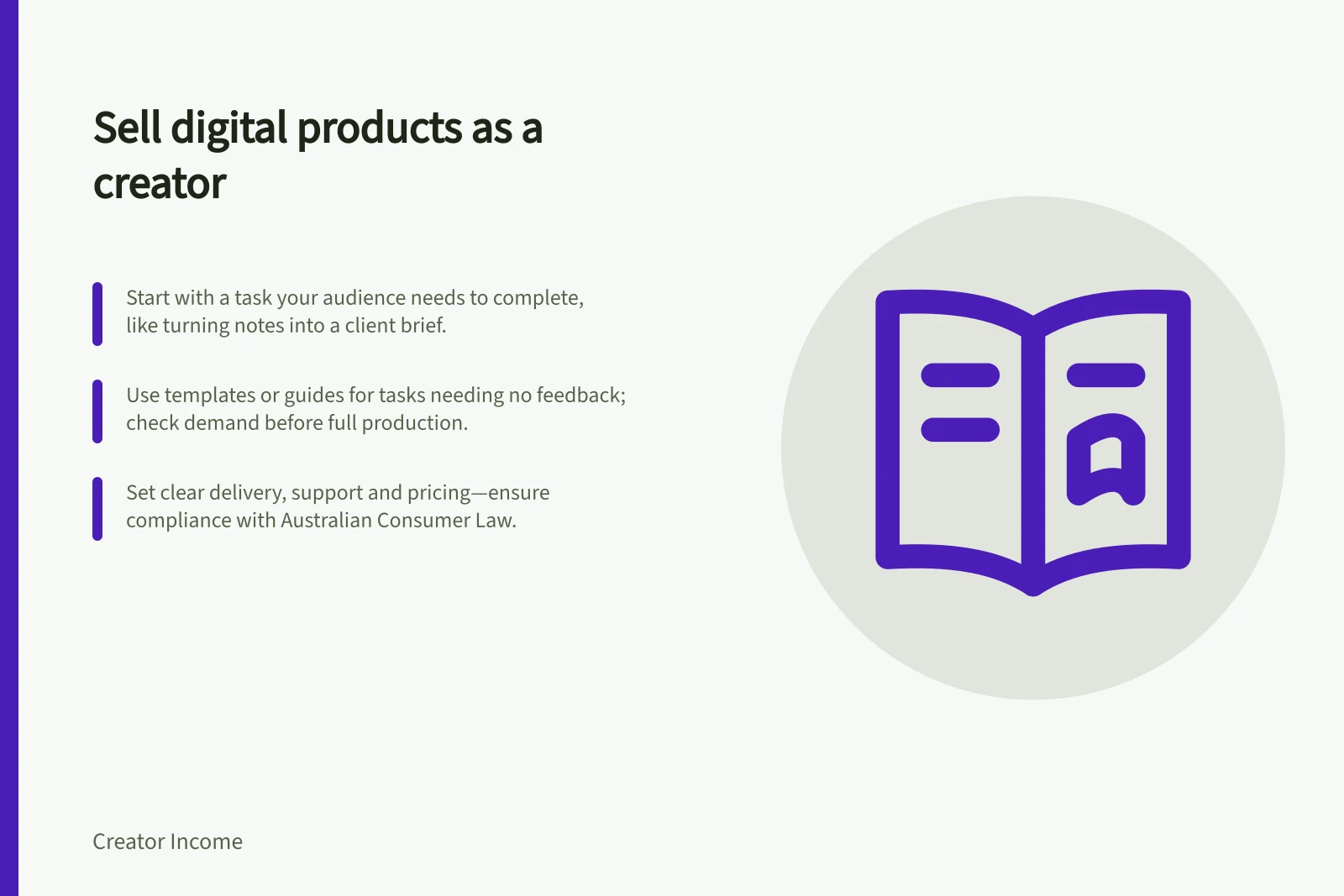
Start with a task your audience wants to complete. Build a small product for that task, and check demand before committing to large production.
The first-product steps are to choose a task and format, check early interest, make the purchase clear, set up delivery and support, then review the first sales. If the task needs no lessons or personal feedback, a template or short guide may serve the buyer better than a course.
Choose the task before the format
Describe the buyer, their starting point and the result the product helps them produce. For example, a worksheet could help a freelance illustrator turn project notes into a first client brief.
Choose a format that fits the work. A checklist suits a sequence of decisions; an editable template suits a document the buyer must make; a guide can explain a method with examples. If the task requires practice and feedback, consider whether a taught format is needed.
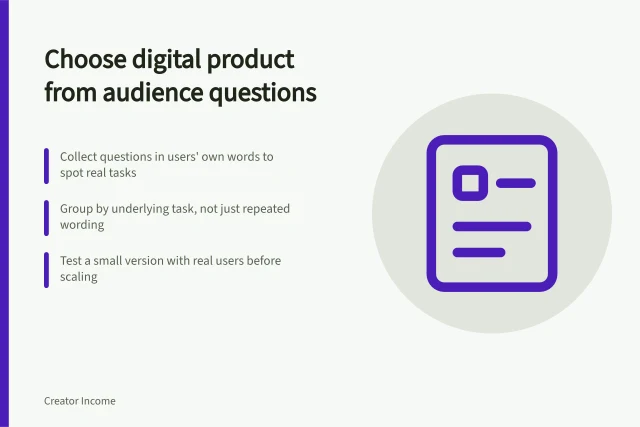
Repeated questions in comments, messages or customer conversations can reveal a candidate problem. Keep the context: “How do I start?” could refer to several different obstacles. Repetition alone does not show that people will pay.
Compare existing options
Before committing to production, review similar products and note what they do well and what could improve. Compare the problem each product addresses and the result it promises to help buyers produce.
Describe your idea and the problem it solves in one or two sentences. Record what you learn so you can refine the offer.
Check the offer before building more
Show potential buyers a clear description of the result, contents, format, access method and price. Ask what they expect to receive and which parts remain unclear. A short survey or interview can help you collect honest feedback.
Treat each response for what it shows. Questions and requests for updates can help refine an offer, while a completed purchase shows someone accepted the stated offer and price. None of these observations predicts how a wider audience will respond.
If you take payment for unfinished work, make its current state, promised contents and delivery terms clear.
Pre-Sale Validation Checklist for Digital Products
- Clear description of the result the product deliversOne or two sentences that explain the buyer’s outcome
- List of contents and formats includedSpecify file types (PDF, DOCX, etc.) and access method (download, link, app)
- Price transparencyShow total price including GST, no hidden fees
- Access duration and updates policyClarify if access is lifetime, time-limited, or includes future updates
- Support and remedy processExplain how buyers can report issues and what remedies apply under ACL
Prototype the core idea
A basic prototype can show the product’s main idea without being finished. For a template, that could be a working version; for a guide, it could be a representative excerpt.
Let potential customers try it and observe how they use it. Ask what they think, then use their feedback to find problems and improve the product. It can also be useful to see what happens when someone uses it in an unintended way.
Make the purchase clear
Before checkout, a buyer should be able to tell:
- who the product is for and what they need to know first;
- which files, lessons or tools are included and in what formats;
- what the product helps them do and what falls outside its scope;
- how long access lasts and whether updates or individual help are included; and
- the payable price, currency and way to report a problem.
Show a representative excerpt where practical. Avoid promising a business result you cannot support. Check permission to reuse any third-party text or images in the product; their availability online does not settle reuse rights.
Set up delivery and support
Choose a selling arrangement that can present the offer, take payment and deliver the promised file or access. Check fees, payout terms, customer contact options and responsibilities under the arrangement and your actual account settings. A checkout service does not necessarily handle every customer issue for the seller.
Examples of services described as handling payments, digital delivery and taxes include Gumroad, EzyCourse, Lemon Squeezy, Sellfy, Payhip and Shopify. Check the current features, fees and payout terms before choosing a service.
Before opening sales, check the purchase and access path from a buyer’s perspective. Confirm that the delivered file opens and its instructions match the version sold. Check that the help route works.
Make the total price and any fees clear before purchase. Explain how buyers can seek help or a remedy without suggesting that digital delivery removes applicable consumer guarantee rights. The remedy depends on the problem and circumstances.
Digital Product Delivery Platforms: Pros and Cons
- ProsAutomated delivery, integrated payments, tax handling (e.g., GST), customer support tools, and scalability
- ConsPlatform fees, limited control over refund processes, possible delays in payouts, and shared responsibility for compliance with Australian Consumer Law (ACL)
Choose a selling channel
Creators can sell through an online store on their own website, an online marketplace or a social media store. An online store can support browsing, orders and delivery logistics; a marketplace may be quicker to set up and already attracts customers.
eBay, Amazon and Etsy are examples of online marketplaces. Some social media platforms, including Facebook, also have an online marketplace. An online store on your website can use an ecommerce platform or plug-in, which may have ongoing subscription costs and transaction fees.
Marketplaces offer less control over store policies and presentation, and their fees tend to be higher than an ecommerce platform on the seller’s own website. Some social media stores generally redirect customers to the seller’s website to make a purchase, rather than handling payment themselves.
Selling Channels for Digital Products in Australia
- Online Store (Your Website)Full control over branding, pricing, and policies. Uses platforms like Shopify, Gumroad, or Lemon Squeezy. May include ongoing subscription and transaction fees.
- Online Marketplace (e.g., Etsy, Amazon, eBay)Faster setup and built-in traffic. Higher fees and less control over store presentation and policies.
- Social Media Store (e.g., Facebook Shop)Often redirects buyers to your website for checkout. Limited payment handling; may not manage disputes or refunds.
Prepare for customer problems
Make sure the help route can handle questions about access as well as faults in the product. Under the Australian Consumer Law, if a product has a major fault, a consumer is entitled to a refund or replacement, or may request a repair, within a reasonable timeframe. Businesses cannot restrict consumer guarantee rights, including for digital products.
The ACCC accepts online enquiries and reports about potential consumer-law problems. It uses reports to inform its education, compliance and enforcement work.
Learn from the first sales
Keep records of completed purchases, refunds, access problems and questions buyers ask while using the product. Separate customer charges from fees, costs and money received. Repeated support questions may point to an unclear instruction or a missing step.
A platform payout may be net of fees, refunds, chargebacks or cancellations, so it may not equal gross sales. Check the sales and support records together to decide what needs clarifying or fixing.
Decide who will update examples when a tool or rule changes. Honour what existing buyers were promised.
Key Compliance and Financial Considerations for Australian Creators
- Australian Consumer Law (ACL) RightsConsumers have rights to refunds, replacements or repairs for major faults in digital products
- ACCC Enforcement ActionBooktopia paid $6 million for misleading claims about consumer guarantee rights
- Tax Reporting for Sole TradersIncome from multiple platforms must be reported to the ATO using an ABN and through myGov/Business Activity Statement
Keep a record of product changes
When you revise the product, check that the updated version still matches the offer buyers saw. Keep a record of changes so you can see what was updated and why.
Keep the core product useful by addressing real issues found during use. Avoid adding features without a clear connection to the buyer’s task.
In this guide
- Choosing a digital product from recurring audience questionsTurn repeated audience questions into a focused digital product brief without mistaking comments for proven demand.
- Testing demand before producing a large course or guideUse a clear offer, representative sample and bounded purchase test to assess demand before committing to a large creator product.