Revenue Planning
Part of Creator newsletters as a business
Estimating revenue from actual engaged readership metrics
Use paid accounts, deliveries and observed actions to build newsletter revenue scenarios without treating list size as guaranteed reach.
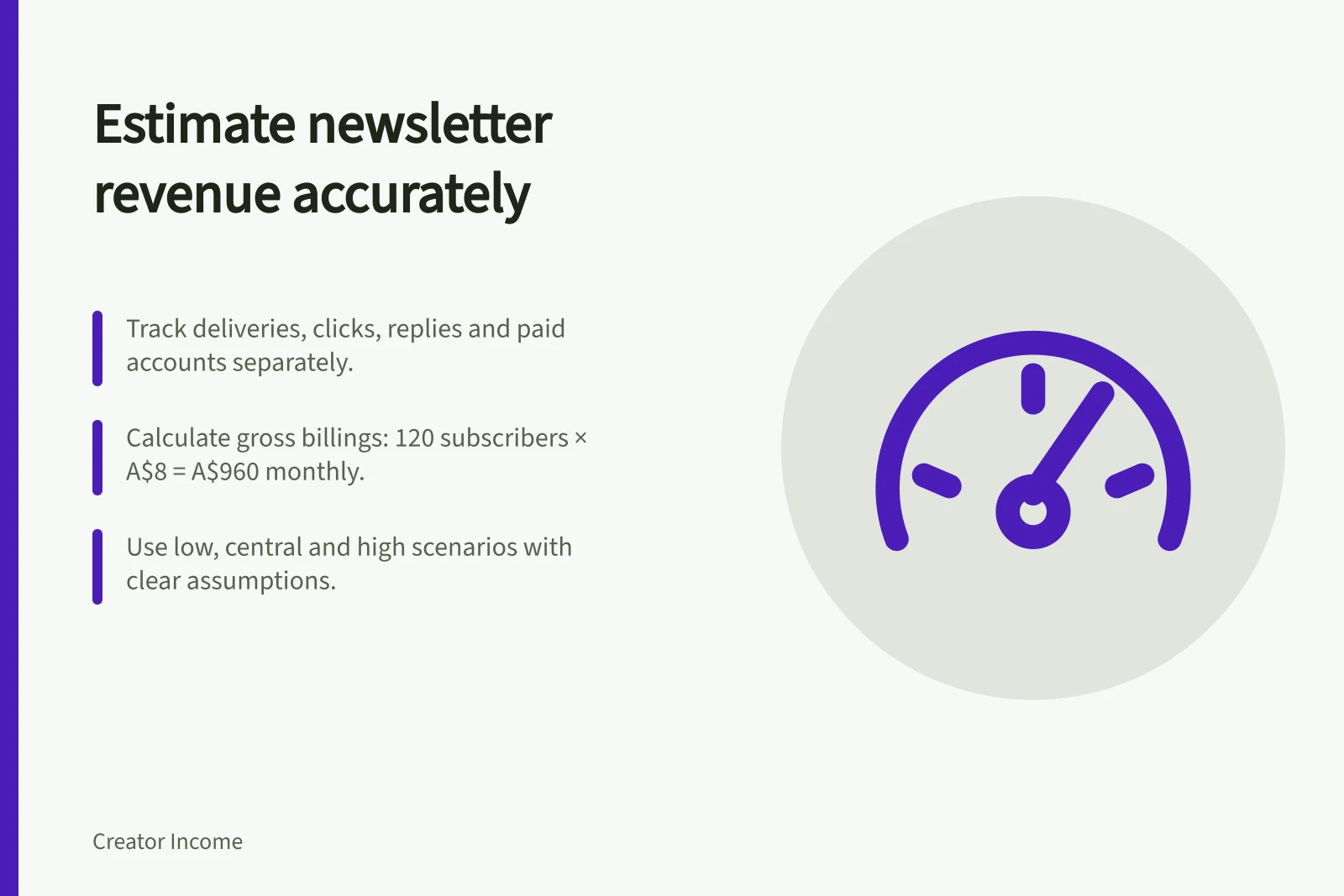
Estimate newsletter revenue by keeping observable readership actions, payment counts and revenue calculations distinct. Total subscribers are a list count, not a guarantee of audience or income; deliveries, clicks, replies, paid accounts and completed sales measure different things.
Build a measurement ladder
For each issue, record addresses eligible to receive it and messages accepted for delivery. Then record the offer-related actions that matter, such as sponsor-link clicks, replies, paid signups or renewals. Keep the counts separate: delivery does not prove a human read an email, and a click on one link does not establish that a reader saw every placement.
For example, 30 sponsor-link clicks from 2,000 successful deliveries in the September issue gives 30 ÷ 2,000 = 1.5% clicks per successful delivery. This is a rate of observed clicks, not proof of 30 unique human readers or a measure of the value of a sponsor placement.
Treat opens cautiously. Email open tracking commonly depends on a small image loading, and automated activity can inflate reported opens or clicks in some email tools. Use opens as a rough diagnostic, if at all, and avoid presenting them as a verified count of engaged people.
For a newsletter without useful links, engagement may show up in replies, direct visits or purchases. Those indicators are incomplete too: some readers gain value without taking a measurable action. Describe these as observed engagement and record the observation window and method.
Model each revenue stream separately
For paid subscriptions, multiply active paying accounts by the price for the same billing period. With 120 active paid subscribers at A$8 per month, 120 × A$8 = A$960 in gross monthly billings if every payment succeeds. This is not take-home income: failed payments, refunds, platform and payment charges, and the cost of producing the promised issues have not been deducted.
If ten accounts cancel and five new accounts start before the next comparable billing period, 120 − 10 + 5 = 115 accounts. At A$8 each, 115 × A$8 = A$920 in gross billings, assuming every payment succeeds. These are illustrative calculations, not a typical renewal rate.
Keep annual and monthly plans separate. Do not add a year's payment to a month's payment and call the result monthly recurring revenue; state whether the figure is cash received, billed sales or revenue allocated across the service period.
For sponsorships, let B be the number of placements likely to be sold and F the agreed or clearly assumed fee per placement. The gross sponsorship estimate is B × F; for one booked placement, that is 1 × F = F. The 1.5% click rate can describe observed response, but it does not establish F, so do not derive a sponsor fee from clicks or total list size.
For products or services promoted to readers, distinguish clicks and enquiries from completed sales. If C is the number of relevant clicks, S the completed sales attributed to the newsletter, and P the price per sale, the observed click-to-sale rate is S ÷ C and gross sales revenue is S × P. A click can lead nowhere, and a later sale may have several influences, so state when attribution is uncertain.
Revenue Stream Contribution by Source
- Sponsorship (1 placement)Agreed fee F
- Product Sales (attributed)S × P (observed)
Use scenarios instead of a single confident figure
The A$960 and A$920 subscription figures are gross billings, not net income. To estimate an amount after costs, subtract actual failed payments, refunds, platform and payment charges, and production costs; without those figures, a net amount cannot be calculated.
For an actual forecast, make low, central and high cases by changing only assumptions you can explain: paying accounts due to renew, likely completed sponsor bookings, or expected costs. Mark any untested conversion or sales assumption, then update the cases with collected payments and signed sponsor commitments after each period.
Put the denominator, time period and definition beside every rate. “Thirty sponsor-link clicks from 2,000 successful deliveries in the September issue” is interpretable; “30 engaged readers” claims more than the click data establish.