Revenue Planning
Part of Creator newsletters as a business
Free versus paid newsletter models
Compare free, paid and mixed newsletter models by reader value, revenue evidence and the work each model requires.
Choose a free newsletter when broad access is central to its purpose, or when revenue comes from a separately measured offer. Choose paid when readers can identify a continuing benefit worth buying and you can deliver it throughout the subscription. A combined model works only if the difference between tiers is clear.
Compare the exchange
| Model | Reader decision | Revenue question | Operating burden |
|---|---|---|---|
| Free | Is this worth an email address and attention? | Will sponsorship or a separate offer produce collected revenue? | Publishing, list care and any sponsor work |
| Paid | Is the stated benefit worth a recurring charge? | Will retained subscriptions cover production and support? | Billing, access, support and renewals |
| Free plus paid | Is the paid addition distinct enough to buy? | Does the added revenue justify maintaining two promises? | Both sets of work and a clear tier boundary |
A free newsletter can be a complete publication. It need not be a sample with its most useful material withheld.
If it carries advertising, say what is sponsored and keep editorial decisions under the creator's control. If it leads to consulting or a digital product, measure those sales separately. Reader growth by itself is not revenue.
A paid newsletter needs a benefit that recurs: for example, a research note, detailed analysis or access to a defined archive. More email is not automatically more value. State the frequency, subject, access period and what happens when a scheduled issue is delayed. Avoid promising personal answers to every subscriber unless capacity allows it.
Decide where a free tier ends
A sensible tier boundary follows the work. A public edition might explain what happened and why it matters; a paid edition might provide a worked method or dataset the creator maintains. Both descriptions should be accurate. If the paid tier merely repeats the free email with a longer introduction, readers will struggle to see what they purchased.
Write two sample issue outlines before selling either tier. Check that each can stand on its own, that the paid addition has a repeatable production process and that the combined workload fits the publishing schedule. An occasional paid special report may be a better offer than a recurring subscription if the work cannot support regular delivery.
Test the economics without a conversion promise
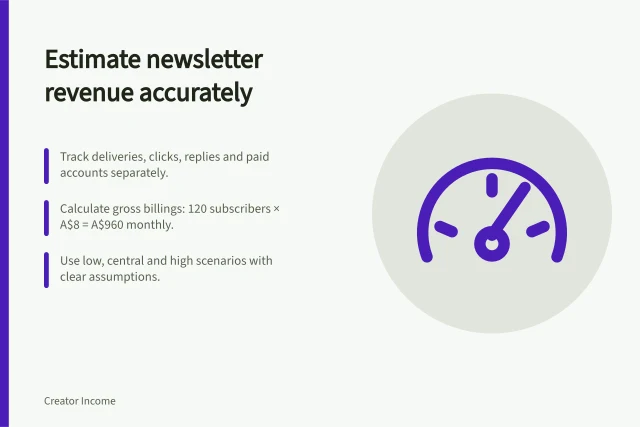
For a paid tier, start with the amount actually billed and paid, then subtract refunds, payment fees, software costs and the time needed to produce and support it. Track active subscribers and renewal cohorts separately from free subscribers. A forecast based on a guessed percentage of free readers converting can be useful as a scenario, but it is not evidence of demand.
For a sponsor-funded free edition, price against the placement, editorial work and defensible delivery or response data. Keep unsold placements out of expected revenue. For a mixed model, check whether sponsor commitments alter the experience paid subscribers were promised.
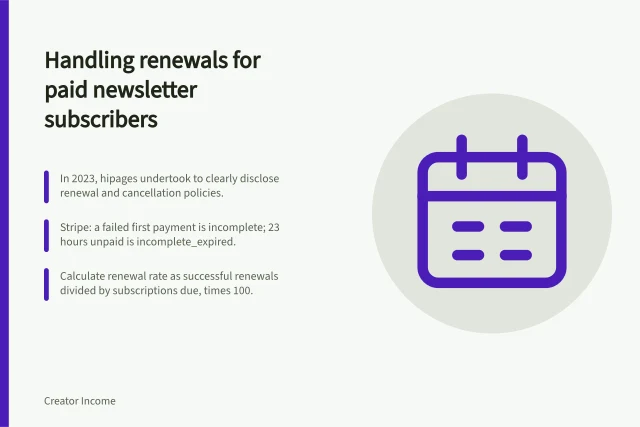
Make billing terms visible before sign-up: the price, billing interval, renewal behaviour and cancellation path. Australian consumer guidance stresses clear, upfront disclosure of important renewal and cancellation terms. A reader should be able to understand the commitment without searching through a separate sales pitch.