Revenue Planning
Part of Creator revenue measurement
Forecasting creator income with explicit uncertainty
Build creator income scenarios from documented payment conditions and assumptions, then compare forecast cash with actual receipts.
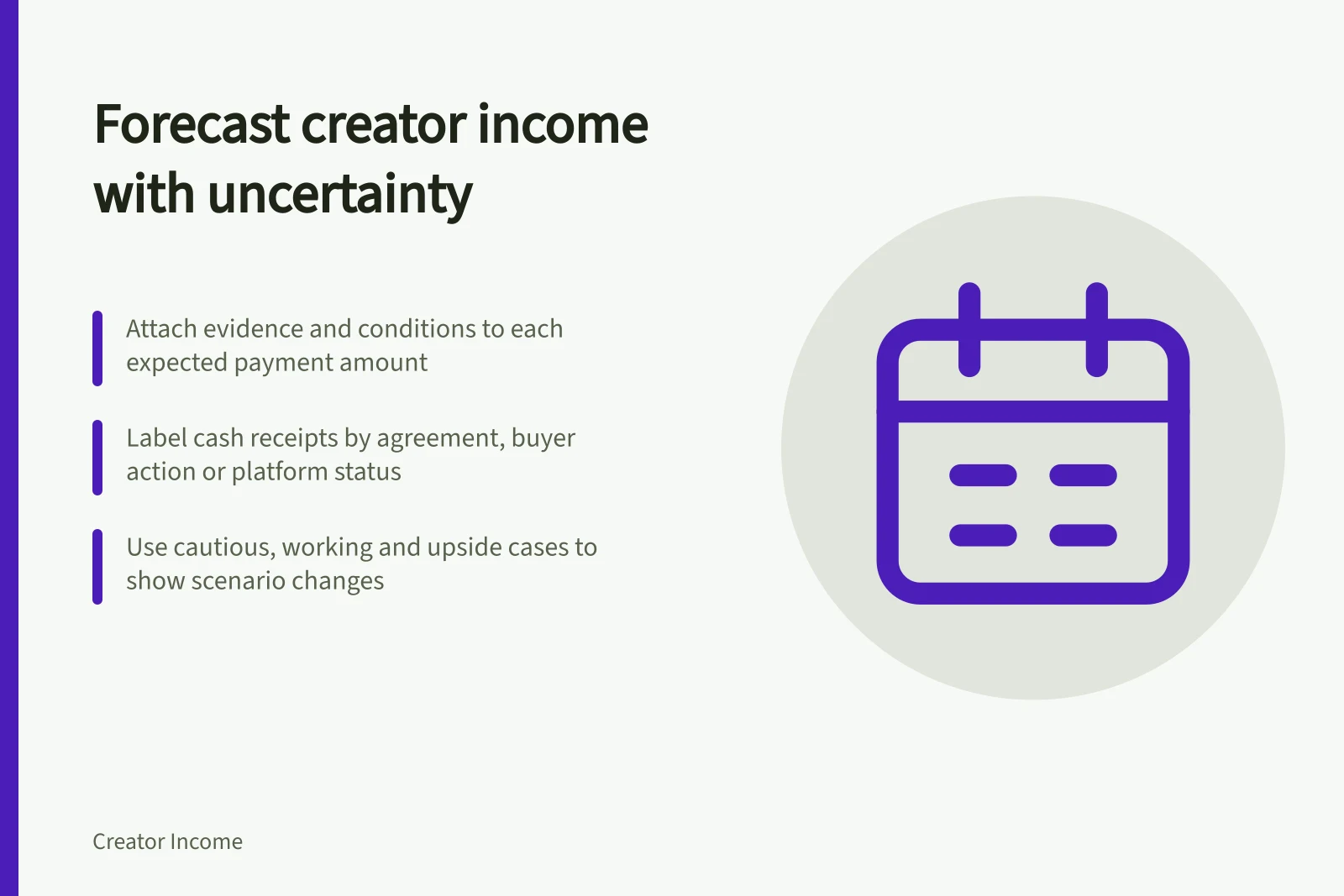
Forecast creator income by attaching evidence and a condition to each expected amount. Label payments with supporting agreements, those dependent on a future buyer or platform action, and assumptions. Put expected cash in the period it may arrive; an unlabelled total hides the uncertainty a spending decision needs.
Key Forecasting Principles for Australian Creators
- Include GST basis
- State whether figures include GST as per ATO requirements
- Forecast cash receipt dates
- Use expected payment dates, not just invoice dates
- Label all conditions
- Mark each income line with supporting agreement or assumption
Choose the forecast basis
Set a horizon that matches the decision, such as the next few months. State the currency, whether figures include GST, and whether the forecast shows expected cash receipts or another defined measure. For a bill due next month, use expected cash dates. An unpaid fee is not cash available today.
For each line, record the amount or range, supporting record, plausible receipt period and remaining condition. An accepted but unpaid fee depends on collection. A proposed sponsorship depends on acceptance and payment. An estimate of future memberships depends on successful charges and possible refunds, even when current members have paid before.
| Evidence state | Example | Treatment |
|---|---|---|
| Received | Payment already in the bank | Keep in actuals, outside future receipts |
| Agreed and unpaid | Accepted fee with payment terms | Forecast a receipt period while showing collection risk |
| Reported but unsettled | Platform amount under its stated definition | Check whether it is estimated or payable before assigning a date |
| Repeated but uncommitted | Past renewals or payouts | Use as a labelled assumption with an alternative case |
| Possible | Enquiry or unaccepted proposal | Keep in an upside case until the required agreement exists |
An invoice alone does not prove the buyer accepted a proposal. These are planning labels, not universal accounting categories; keep the relevant agreement, report or transaction record.
Change named inputs across scenarios
Build a cautious, working and upside case by changing specific conditions and dates. Do not add an unexplained percentage to a total.
A cautious case might delay collection and assume fewer successful renewals. A working case might use a documented payment term and a stated renewal assumption. An upside case can include a proposal only if its remaining acceptance and payment steps are visible.
Suppose, purely for illustration, a creator has an accepted A$600 client invoice due next month, assumes A$200 from future member renewals, and is discussing an unaccepted A$400 sponsor proposal. If the invoice and renewals both slip beyond the month, these items contribute A$0 to that month's cash.
If the invoice is paid on time and the assumed renewals succeed, they contribute A$800. If the sponsor also accepts and pays within the month, the total becomes A$1,200.
These are conditional calculations, not probabilities, typical results or a claim that the middle case is most likely. State the GST basis when using real amounts.
Place expected outgoings and existing cash beside the cases before deciding whether a bill can be paid. Australian business guidance describes cash forecasts using estimated money in and out and calls for estimated costs and the GST basis to be identified.
Update lines when evidence changes
Name the event that would change each line: buyer approval, a renewal charge, platform confirmation, invoice payment or a refund. Note when to check it and retain the earlier forecast. For a new offer with no completed sales, describe sales as a scenario rather than a likely amount merely because a spreadsheet contains a number.
At period end, compare actual receipts with the earlier forecast. Separate differences caused by volume, timing, refunds and proposals that never became agreements. Use the findings to revise the next forecast while preserving the old assumptions.