Revenue Planning
Creator revenue measurement
Track creator revenue by source, payment stage and delivery work, then review comparable periods without treating estimates as cash.
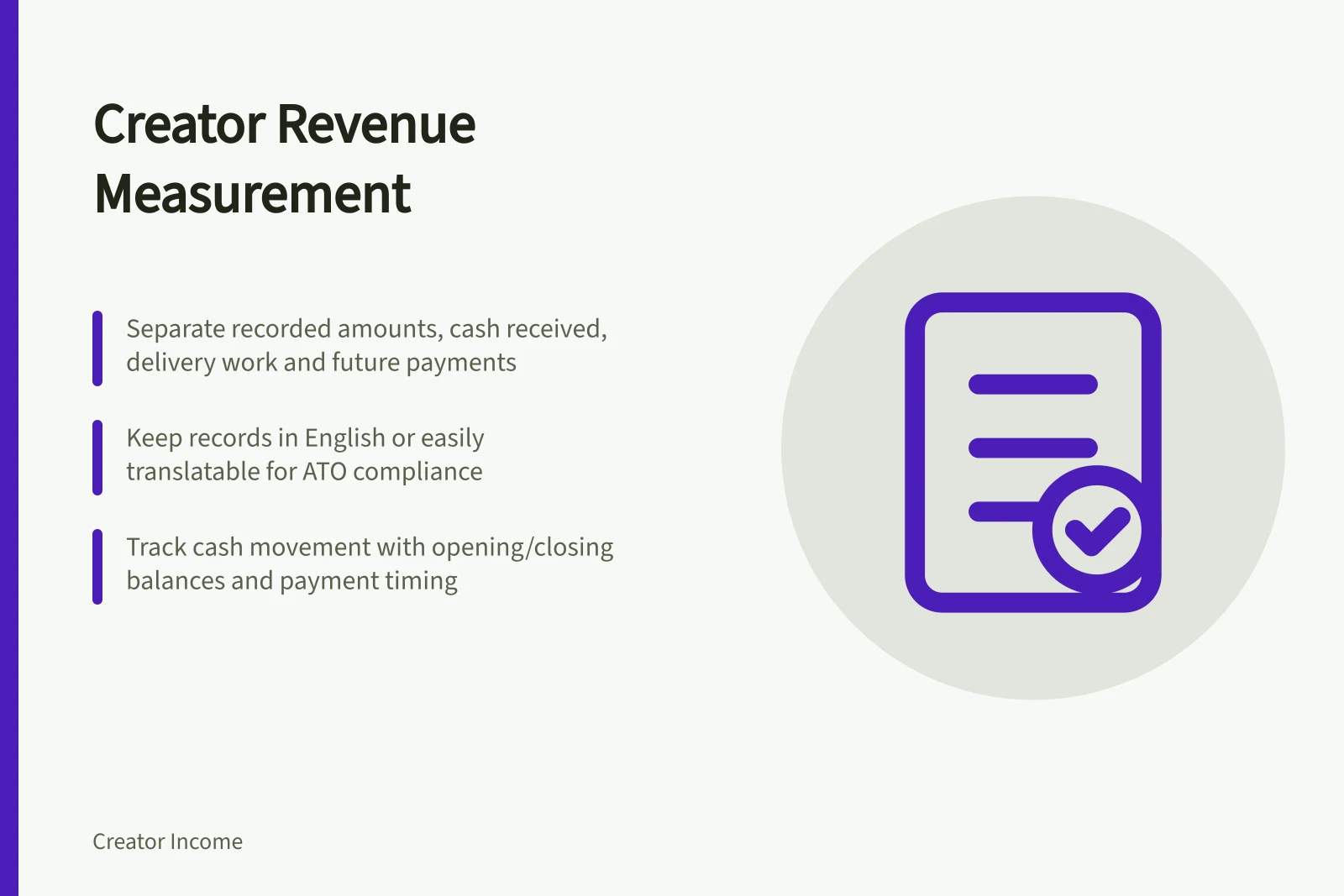
Measure creator revenue with a view that separates recorded amounts, cash received, delivery work and uncertain future payments. Set a defined period, currency and GST basis. A customer charge, a platform report and a bank deposit may describe stages of one transaction; adding them together would overstate the result.
Build a measurement view
Start with a monthly summary and retain the records behind it. For each source, identify who pays, what creates the payment, which agreement or report explains the amount, and when cash arrives.
| Question | Measure to keep | Decision it supports |
|---|---|---|
| Where did the amount come from? | Source, offer and transaction reference | Which activity produced it |
| Has cash arrived? | Amount outstanding, amount received and receipt date | What can cover upcoming payments |
| What did delivery require? | Direct spending and hours, with shared costs identified separately | How much work the offer creates |
| What may change? | Pending amounts, refunds and disputed or late payments | How cautiously to plan |
Treat this as a management view, not a profit and loss statement or tax return. Australian business guidance calls for records of income, expenses and bank transactions; these categories are a suggested way to organise them.
Keep an evidence trail
Australian businesses must keep records of transactions related to tax, superannuation and registrations. Records must be in English or easy to translate into English, and should support the amounts and statuses in your measurement view.
The record set includes income and sales transactions, business expenses including cash purchases, bank records and expenses related to assets or stock.
It can also include end-of-year lists of creditors and debtors, GST records if registered, fuel tax credit records if claiming them, and employee and contractor records.
The ATO accepts digital or paper records and recommends digital record keeping where possible. Electronic images of paper records must be true, clear reproductions and follow record-keeping rules. Store records securely, back up digital files and keep access to the devices and passwords needed to retrieve them.
Keep payment stages distinct
Label an amount as proposed, agreed, reported by a platform, invoiced, received or adjusted, as applicable. These are planning labels, not accounting recognition rules. A sponsor enquiry is a possibility; an accepted fee has supporting terms; an invoice requests payment; a bank record confirms receipt.
Link changes in status to the original transaction so one payment does not become several sales.
Read a platform report's definition before using its figure. It may be an estimate, a payable amount or a payout after deductions. Check whether a platform share or refund is already reflected before subtracting it again. Retain the report and explain differences from the later deposit.
State whether a combined view includes or excludes GST. Keep original currency amounts and document any conversion used to show them in Australian dollars.
Track cash movement separately
A cash movement schedule gives the period a clear opening and closing position. Calculate the monthly cash balance by subtracting cash outgoing from cash incoming. Add the opening bank balance to the monthly cash balance to get the closing balance; that closing balance becomes the next month's opening balance.
Classify incoming cash by when it reaches the business, such as sales, debtor receipts, grants or tax rebates. Record outgoing payments in the period they are paid, including items such as purchases, marketing, rent and utilities, rather than treating an unpaid cost as cash already spent.
Use the cash view to spot payment cycles and seasonal patterns, and to assess whether income is likely to cover costs when they fall due. A forecast can draw on previous years, seasonal trends, regular income sources and major costs; label and explain estimated figures so they remain distinct from actual results.
Record the work behind the receipts
Record delivery effort alongside the revenue source and period. Keep shared expenses visible until you can apply a stated allocation method. Show a planning value for your own hours separately from cash paid to others.
Review receipts alongside delivery effort and cash timing. These measures do not by themselves show profit or personal take-home pay: shared overhead, future delivery and tax may still matter. If one video earns a platform payout and a separate sponsor fee, record each payment under its source but record production time only once.
Review comparable periods
Compare figures with the same definition and period. A large project payment can make one month look strong even if much of the work occurred earlier. Note when work was delivered and when payment arrived.
For a recurring offer, distinguish charges due, successful payments and refunds. For project work, distinguish agreed fees from collections.
When a total changes, check whether the cause was transaction volume, the amount per transaction, refunds, deductions, payment timing or delivery effort. Keep a short explanation with the period's figures. Put next period's assumptions in a separate forecast and update them as evidence arrives.
A separate profit and loss view can show sales and expenses for a period, while the cash view tracks money flowing in and out. Choose a monthly, quarterly or yearly period, use it consistently, and clearly mark figures as actual or forecast.
If a period includes estimates, label them clearly, and state whether profit and loss figures include or exclude GST.
In this guide
- Tracking income by revenue sourceSet up a traceable source ledger for creator income and separate reported, pending and received amounts without double counting.
- Measuring fulfilment costs for creator offersRecord direct spending, creator delivery hours and shared costs so an offer's workload is visible beside its receipts.
- Forecasting creator income with explicit uncertaintyBuild creator income scenarios from documented payment conditions and assumptions, then compare forecast cash with actual receipts.