Memberships
Part of Paid creator memberships
Pricing a creator membership around ongoing audience value
Set a creator membership price from its recurring value, delivery costs, real fee rules and cautious paid-member scenarios.
Set a recurring membership price by identifying the benefit members receive each billing period, then checking that a candidate buyer price can fund its delivery. Followers are not paying accounts; completed payments and renewals are more useful evidence of demand.
Describe what the member is buying
State what is available immediately, what new benefit arrives each billing period, and who the tier serves. Some members may chiefly want useful analysis; others may want to support continuing public work, so describe the exchange you actually offer.
Ask members which benefits they use, would miss, or would renew for, and ask prospective members what they would pay for. Treat answers as clues, then check them against completed payments and renewals.
Weigh the effort required to use each benefit: a live session takes place at a set time, feedback may require a submission, and an archive may be useful straight away. If there are two tiers, explain their practical difference; more tiers do not create value by themselves.
Build a workable price floor
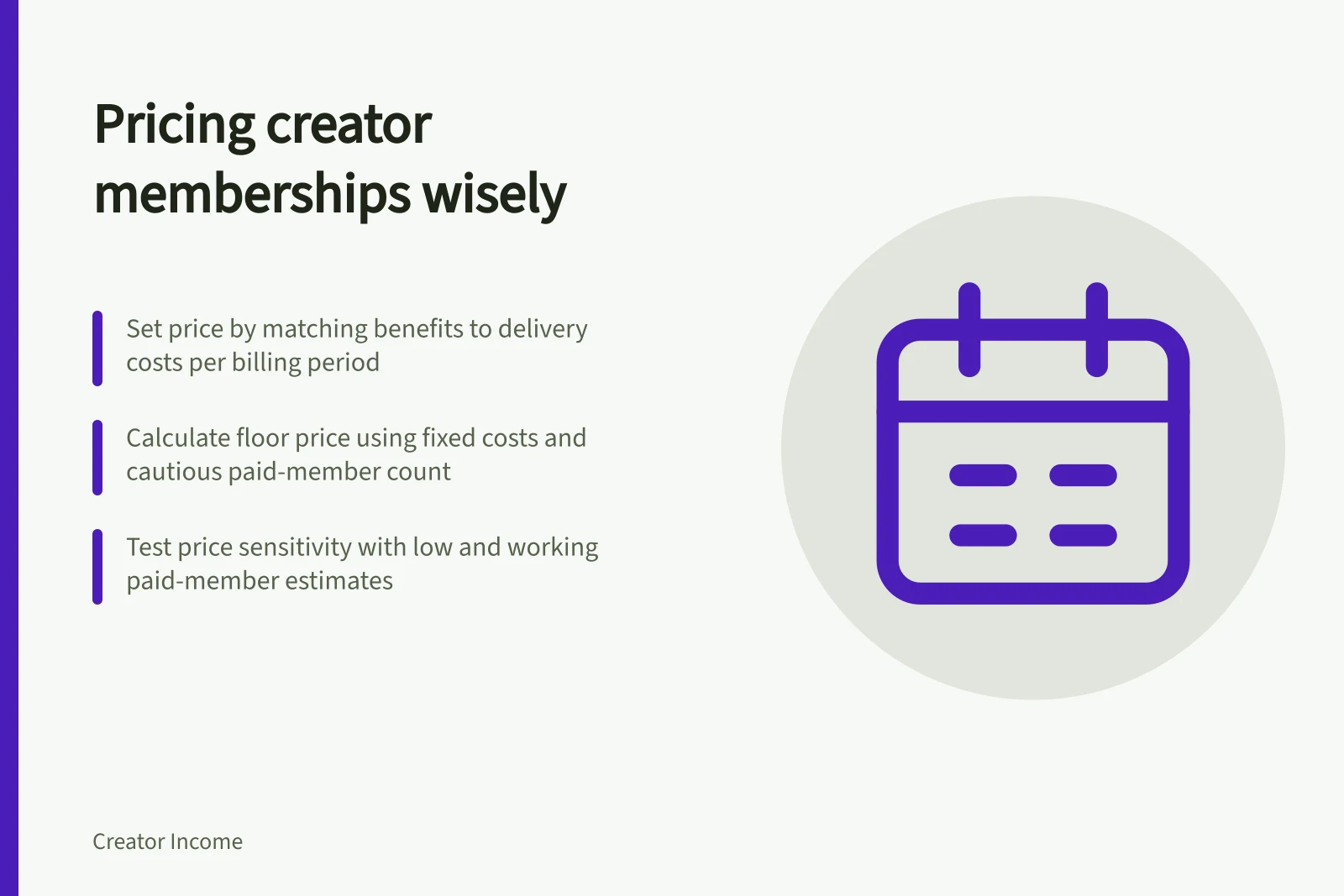
Count creator time at an internal hourly cost you choose, alongside other fixed monthly delivery costs. Add costs each member brings, including administration, support and refunds, and account for the platform and payment deductions that apply to your setup.
For each billing period, required net per member = fixed delivery costs ÷ cautious paid-member count + delivery costs added per member. The floor is the lowest buyer price that, after actual platform and payment deductions, leaves at least that required net per member.
For Patreon, check “Creator fees overview”; for Ko-fi, check “Ko-fi Memberships and Membership Tiers”, as well as the payment-provider terms for your setup. Use the deductions that apply to your account in the calculation.
A resource made once for all members may carry similar production work at different membership counts, while individual reviews add work as requests grow. Bound or cap a personal-help tier before pricing it, and reduce the delivery burden or revise the offer if its floor is higher than the recurring benefit you can credibly explain.
Test sensitivity to paid-member counts
At a given monthly price, more successful payments produce higher gross member charges than fewer successful payments. Treat that comparison as arithmetic, not a price recommendation or evidence of demand.
Use a low case and a working case based on paying accounts, not followers. A cautious count is a deliberately conservative estimate grounded in any existing paid activity or observed intent; if you have no payment history, state the assumption plainly and revise it when payment records arrive.
For each candidate monthly price, recalculate the fixed-cost share and delivery floor in both cases, then check whether the price covers that floor and is supported by the recurring benefit. A lower paid-member count raises the fixed-cost share, so it can change whether the price is workable.
Customer charges, platform-reported earnings and cash received can differ, so keep them separate when checking whether the price covers delivery.
Display and review the price
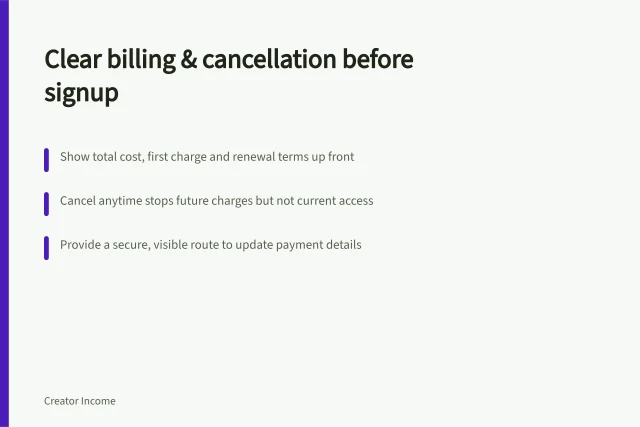
Make the price, currency and billing interval clear before signup; if there is a minimum term, make its total cost clear too. Check the ACCC’s “Price displays” guidance; the ACCC says it does not give businesses legal advice about how they display prices.
A hosted platform’s tax and checkout treatment depends on the transaction, so check the amount the buyer actually sees before signup.
Before changing a price, reassess the recurring benefit and delivery floor, then check the platform’s current terms and settings. For Patreon, consult “How to adjust your membership tier prices” to see how existing members may be affected.
Tell affected members the new amount and effective date, and verify any required notice period rather than assuming one. Check that the platform settings reflect the change, then recalculate if delivery costs or platform and payment deductions change.