Revenue Planning
Part of Creator service businesses
Turning expertise into a clearly scoped service
Define a creator service through the client problem, inputs, deliverable, completion point and exclusions before quoting.
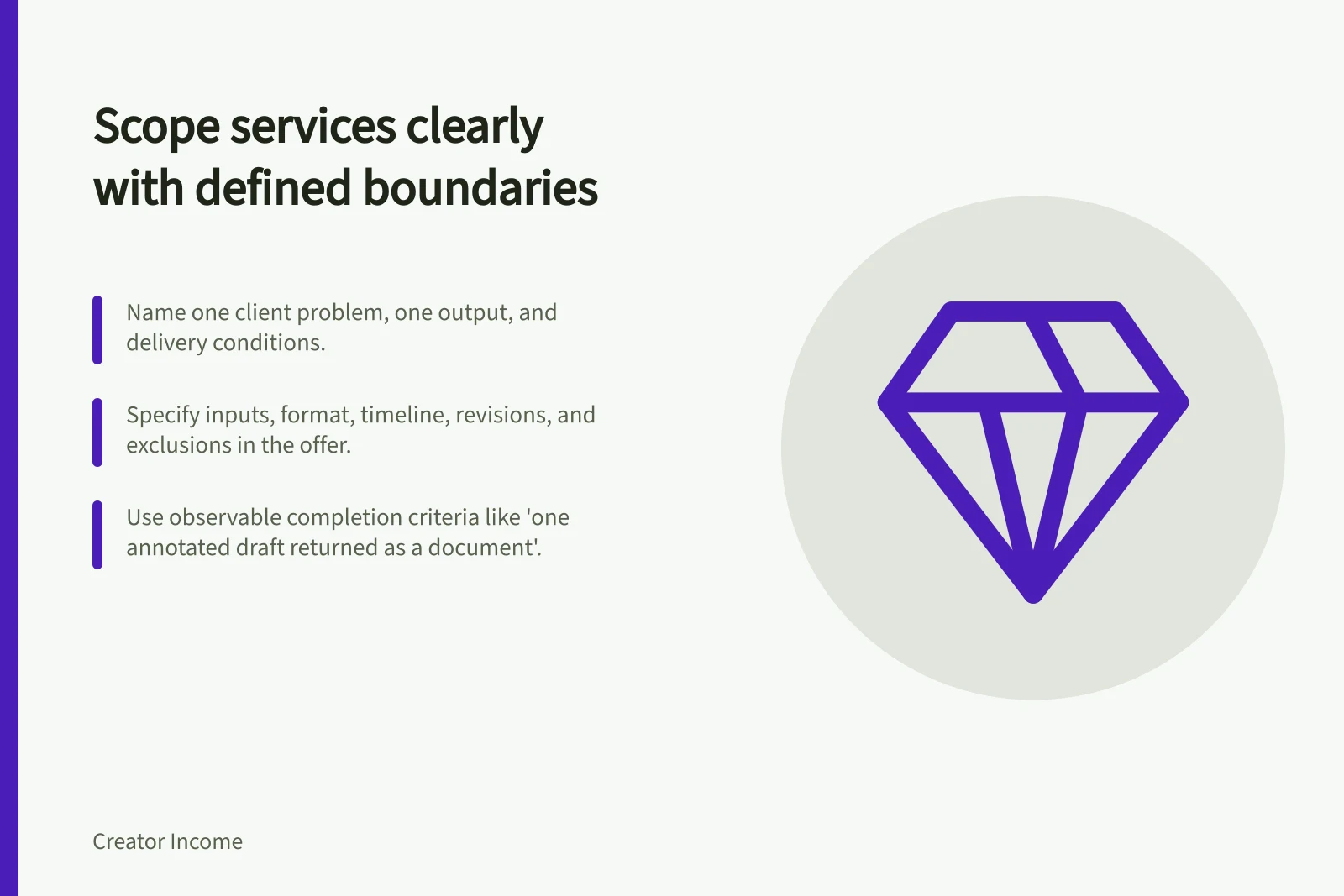
Turn expertise into a service by naming one client problem, one useful output and the conditions under which you can deliver it. The scope should let a client decide whether the offer fits and let you tell when the work is finished.
Find the task inside a broad request
Begin with a question clients bring to you. “Help with video” might mean planning a script, editing footage or reviewing a finished cut. Ask what the client has now, what decision or asset they need next, and who will use the result. Choose one task you can perform well.
Write a working offer sentence: “For [client and situation], I will [specific work] and deliver [output] after receiving [inputs].”
For example, a creator who explains audio editing could offer to review one supplied podcast episode and return a list of time-stamped changes. This is an illustrative offer, not evidence of demand or a promise that every episode can be resolved in one review.
Set the edges of the job
A usable scope answers six questions:
- What must the client supply, and by when?
- What will you examine or produce?
- What format will the client receive?
- When will you deliver it after receiving complete inputs?
- What feedback or revision is included?
- What request would need a new quote?
Name exclusions a buyer might reasonably assume are included. A script review, for instance, may exclude rewriting the full script and checking specialised claims. Put important exclusions beside the offer.
Define completion in observable terms. “One annotated draft returned as a document” is easier to check than “content improved”. Avoid guaranteeing audience growth, sales or another result that depends on work beyond your control.
Check the quote against the work
Estimate briefing, production, communication, any included revision and handover. Account for direct costs and the return you need from the job. State the fee, payment timing, dates and GST treatment where applicable.
Australian government guidance says a written quote should describe the work, costs, applicable GST, payment terms and any variations or revisions discussed.
If the client needs an outcome you cannot define yet, offer a bounded discovery stage. Say what it will deliver, such as a diagnosis and proposed next scope. Quote the later project when you understand its inputs.
Check understanding before acceptance
Send the offer in plain language and ask the client to confirm the deliverable, their inputs and who can approve feedback. Record any agreed change to the work, fee or timetable. The accepted quote or agreement should reflect the job you will deliver.
After delivery, note extra steps clients repeatedly request. Decide whether to include and price one in a revised offer or keep it as a separately quoted option.